

Embarking on a journey into the future of healthcare, the Top 10 health tech innovations to watch in 2025 promise groundbreaking advancements that will reshape the way we approach medical care. From artificial intelligence to wearable health technology, these innovations are set to revolutionize the industry as we know it.
Let's delve into the realm of possibilities that await in the coming years.
Overview of Health Tech Innovations
Health tech innovations refer to the use of technology in healthcare to improve diagnosis, treatment, and patient care. These advancements encompass a wide range of tools and solutions, including wearable devices, telemedicine platforms, artificial intelligence, and more.
Staying updated with the latest health tech innovations is crucial as it allows healthcare professionals to provide more efficient and effective care to patients. By incorporating cutting-edge technologies into medical practices, providers can enhance diagnosis accuracy, streamline treatment processes, and ultimately improve patient outcomes.
Impact of Technology on Healthcare Delivery and Patient Outcomes
Technology has revolutionized healthcare delivery by enabling remote consultations, personalized treatment plans, and predictive analytics. This has resulted in improved access to care, especially for underserved populations, and has helped reduce healthcare costs.
Furthermore, the integration of technology in healthcare has led to better patient outcomes through early detection of diseases, personalized medication regimens, and continuous monitoring of vital signs. Patients can now actively participate in their own care and have access to valuable health data in real-time.
Artificial Intelligence (AI) in Healthcare
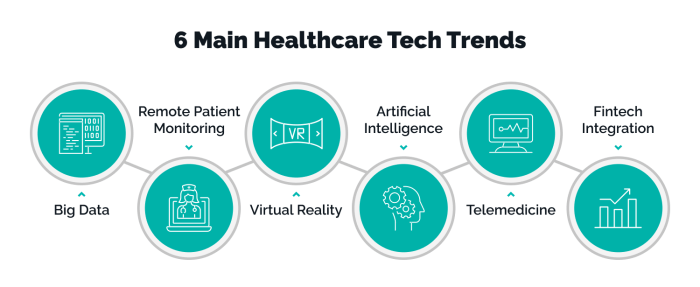
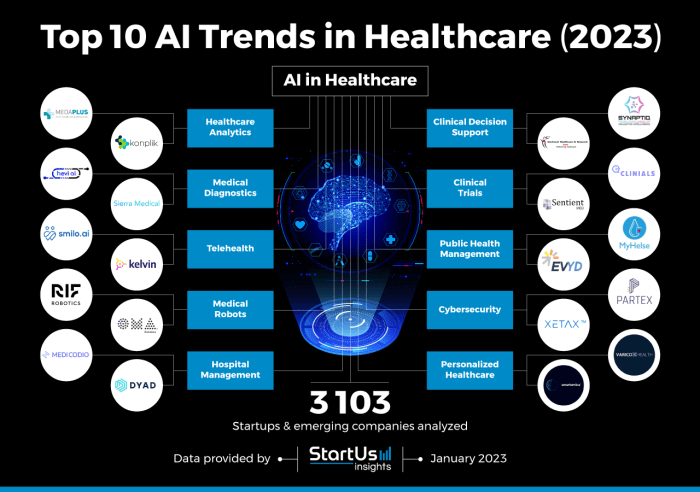
Artificial Intelligence (AI) is transforming the healthcare industry by offering innovative solutions to improve patient care, diagnostics, and personalized medicine. This technology has the potential to revolutionize how healthcare systems operate, providing more efficient and accurate outcomes.
AI Applications in Healthcare
- AI in Diagnostics: AI-powered systems can analyze medical images, such as X-rays and MRIs, to detect abnormalities and assist healthcare professionals in making accurate diagnoses.
- Personalized Medicine: AI algorithms can analyze individual patient data to tailor treatment plans and medications based on genetic makeup, lifestyle factors, and medical history.
- Patient Care: AI chatbots and virtual assistants can provide real-time support to patients, answer medical queries, and monitor health conditions remotely, improving accessibility and efficiency in healthcare delivery.
Benefits and Challenges of AI Integration
- Benefits:
- Improved Accuracy:AI can process vast amounts of data quickly and accurately, leading to more precise diagnoses and treatment plans.
- Enhanced Efficiency:Automation of routine tasks through AI can free up healthcare professionals' time, allowing them to focus on more complex patient care.
- Cost Savings:By streamlining processes and reducing errors, AI integration can potentially lower healthcare costs and improve overall financial sustainability.
- Challenges:
- Data Privacy Concerns:Safeguarding patient data and ensuring compliance with regulations are critical challenges in AI implementation in healthcare.
- Ethical Considerations:Issues related to transparency, accountability, and bias in AI algorithms must be addressed to maintain trust and fairness in healthcare decision-making.
- Integration Complexity:Adopting AI technologies into existing healthcare systems may require significant infrastructure changes and staff training to maximize their benefits effectively.
Telemedicine and Remote Monitoring
Telemedicine plays a crucial role in providing healthcare services remotely, allowing patients to consult with healthcare professionals without the need for in-person visits. This can be especially beneficial for individuals with limited mobility, those living in remote areas, or during situations such as a global pandemic.
Advantages of Remote Monitoring for Patients with Chronic Conditions
Remote monitoring offers numerous advantages for patients with chronic conditions. By using wearable devices and smart technology, healthcare providers can track vital signs, medication adherence, and disease progression in real-time. This continuous monitoring enables early intervention, personalized care plans, and better management of chronic illnesses.
Improving Access to Care through Telemedicine and Remote Monitoring
Telemedicine and remote monitoring have the potential to significantly improve access to care for underserved populations. Patients who face barriers such as transportation issues, lack of nearby healthcare facilities, or limited healthcare providers in their area can benefit from virtual consultations and remote monitoring services.
This can lead to earlier diagnosis, timely treatment, and overall better health outcomes for individuals who may have otherwise struggled to access traditional healthcare services.
Wearable Health Technology
Wearable health technology refers to devices that are worn on the body to monitor various health metrics and activities. These devices have gained popularity in recent years due to their ability to provide real-time data and insights into an individual's health status.
Popular Wearable Devices
- Fitbit: A well-known brand that offers fitness trackers to monitor physical activity, sleep patterns, heart rate, and more.
- Apple Watch: Besides being a smartwatch, it also includes features for tracking fitness, heart rate, and even performing an electrocardiogram (ECG).
- Garmin: Known for its GPS technology, Garmin also offers wearable devices for tracking steps, heart rate, and other health metrics.
Potential Impact on Healthcare
Wearable health technology has the potential to revolutionize preventive healthcare by enabling individuals to track their health data continuously. This continuous monitoring can help in early detection of health issues, allowing for timely intervention and treatment. Additionally, wearables can empower individuals to take charge of their health and make informed decisions based on the data provided by these devices.
Virtual Reality (VR) and Augmented Reality (AR) in Healthcare
Virtual Reality (VR) and Augmented Reality (AR) are revolutionizing the healthcare industry by offering innovative solutions in medical training, patient therapy, and various healthcare applications.
Medical Training and Patient Therapy
Virtual Reality (VR) and Augmented Reality (AR) are being extensively used in medical training to provide immersive learning experiences for medical students and professionals. These technologies allow them to simulate surgical procedures, practice complex operations, and enhance their skills in a risk-free environment.
In patient therapy, VR and AR are used to create interactive environments for pain management, anxiety reduction, and rehabilitation.
Applications in Surgery, Mental Health, and Rehabilitation
In surgery, VR and AR technologies are used to plan and simulate surgical procedures, improving precision and minimizing risks during operations. For mental health, VR is employed in exposure therapy for treating phobias, PTSD, and anxiety disorders by creating controlled virtual environments.
In rehabilitation, AR is used to provide interactive exercises for patients recovering from injuries, strokes, or disabilities, enhancing their recovery process.
Future Possibilities and Advancements
The future of VR and AR in healthcare presents exciting possibilities, such as remote surgeries conducted through virtual reality platforms, personalized treatment plans based on patient data, and mental health interventions using immersive technologies. Advancements in haptic feedback, real-time monitoring, and AI integration will further enhance the capabilities of VR and AR in delivering efficient and effective healthcare solutions.
Blockchain Technology in Healthcare
Blockchain technology has been gaining traction in the healthcare industry due to its ability to enhance security and privacy in data management. By utilizing a decentralized and encrypted ledger system, blockchain ensures that sensitive medical information is securely stored and shared among healthcare providers, patients, and other authorized parties.
This level of security helps protect patient data from breaches and unauthorized access, ultimately improving trust and confidentiality within the healthcare ecosystem.
Enhancing Interoperability and Seamless Sharing of Medical Records
One of the key benefits of blockchain technology in healthcare is its potential to promote interoperability and facilitate the seamless sharing of medical records. Traditional healthcare systems often struggle with fragmented data silos, making it challenging for providers to access and exchange patient information efficiently.
With blockchain, medical records can be securely stored in a transparent and immutable digital ledger, allowing for real-time access and updates across different healthcare organizations
Challenges and Opportunities of Implementing Blockchain in Healthcare
While the potential benefits of blockchain in healthcare are promising, there are challenges to overcome in its implementation. One major hurdle is the integration of blockchain with existing legacy systems, which may require significant resources and expertise. Additionally, ensuring regulatory compliance and data standardization across different healthcare entities can be complex.
However, as more healthcare organizations explore blockchain solutions, opportunities for innovation and collaboration are emerging. By addressing these challenges proactively and leveraging the unique capabilities of blockchain technology, the healthcare industry can unlock new possibilities for data management, security, and interoperability.
Robotics and Automation in Healthcare
Robotics and automation are revolutionizing the healthcare industry by enhancing surgical procedures and patient care. These technologies offer precision, efficiency, and improved patient safety in various healthcare settings.
Role of Robotics in Surgical Procedures
Robotics play a crucial role in surgical procedures by enabling surgeons to perform intricate and precise operations with enhanced dexterity and control. Systems like the da Vinci Surgical System assist in minimally invasive surgeries, reducing incision size, recovery time, and potential complications.
Examples of Robotic Systems in Healthcare
- The CyberKnife System delivers radiation therapy with sub-millimeter accuracy, targeting tumors while minimizing damage to surrounding healthy tissue.
- Robotic exoskeletons help patients with mobility impairments regain strength and movement through repetitive tasks and exercises.
Impact of Robotics on Healthcare Efficiency and Patient Safety
Robotics and automation improve healthcare efficiency by streamlining processes, reducing human error, and enhancing surgical outcomes. These technologies also enhance patient safety by minimizing the risk of complications, infections, and unnecessary procedures, ultimately improving overall quality of care.
Genomics and Personalized Medicine
Genomics plays a crucial role in tailoring medical treatments to individual patients, revolutionizing the field of healthcare. By analyzing an individual's genetic makeup, healthcare providers can personalize treatment plans to target specific genetic variations and optimize outcomes.
Advancements in Genetic Testing and Precision Medicine
- Genetic testing has become more accessible and affordable, allowing individuals to uncover valuable information about their genetic predispositions.
- Precision medicine utilizes this genetic data to tailor treatments that are more effective and have fewer side effects, leading to better patient outcomes.
- Advancements in technology have made it possible to sequence genomes quickly and accurately, paving the way for personalized medicine to become a standard practice.
Potential of Genomics for Predicting Diseases and Developing Targeted Therapies
- Genomics can help predict an individual's risk of developing certain diseases based on their genetic profile, enabling proactive interventions and preventive measures.
- By understanding the genetic mechanisms behind diseases, researchers can develop targeted therapies that address the root causes at a molecular level, improving treatment efficacy.
- The integration of genomics into healthcare systems holds the potential to revolutionize disease management and significantly impact patient outcomes in the future.
Internet of Medical Things (IoMT)
The Internet of Medical Things (IoMT) refers to a network of medical devices and applications that connect to healthcare IT systems through online computer networks. These interconnected devices can collect, analyze, and transmit health data in real-time, enabling healthcare providers to monitor patients remotely and make informed decisions about their care.
Applications of IoMT in Healthcare Devices and Systems
IoMT devices are revolutionizing healthcare by providing numerous benefits such as remote monitoring, chronic disease management, medication adherence, and personalized treatment plans. For example, wearable fitness trackers can monitor vital signs, activity levels, and sleep patterns, helping individuals track their health goals and improve their overall well-being.
Examples of IoMT Devices for Remote Monitoring and Health Management
- Smart insulin pens that track insulin doses and send data to healthcare providers to optimize diabetes management.
- Remote patient monitoring systems that transmit patient data to healthcare professionals for timely intervention and care adjustments.
- Connected inhalers that monitor inhaler usage and provide feedback to asthma patients for better symptom control.
Challenges and Benefits of Integrating IoMT into the Healthcare Ecosystem
Integrating IoMT into the healthcare ecosystem presents challenges such as data security and privacy concerns, interoperability issues, and regulatory compliance. However, the benefits of IoMT, including improved patient outcomes, reduced healthcare costs, and enhanced clinical decision-making, far outweigh these challenges.
With proper implementation and safeguards, IoMT has the potential to transform healthcare delivery and improve the quality of patient care.
Data Analytics and Predictive Modeling
Data analytics and predictive modeling play a crucial role in transforming healthcare decision-making by utilizing large sets of data to identify patterns, trends, and potential outcomes. By analyzing past data and applying algorithms, healthcare providers can make informed decisions, predict potential health issues, and personalize treatment plans for patients.
Improved Patient Outcomes
- Predictive analytics can help identify patients at high risk of developing certain conditions, allowing for early intervention and preventive measures.
- By analyzing patient data, healthcare providers can tailor treatment plans to individual needs, leading to better outcomes and reduced hospital readmissions.
- Health systems can optimize resource allocation based on predictive models, ensuring that patients receive timely and appropriate care.
Cost Reduction
- Predictive modeling can help healthcare organizations identify inefficiencies and areas for cost savings, leading to a more efficient use of resources.
- By predicting potential complications or readmissions, healthcare providers can intervene early, reducing overall healthcare costs.
- Data analytics can streamline administrative processes, reducing paperwork and improving workflow efficiency.
Ethical Considerations and Privacy Concerns
- Ensuring patient data privacy and security is essential when using data analytics in healthcare to protect sensitive information from breaches or misuse.
- Healthcare providers must adhere to strict regulations and guidelines to maintain patient confidentiality and trust.
- Transparent communication with patients regarding data usage and sharing is crucial to address ethical concerns and maintain patient autonomy.
Final Review
As we wrap up our exploration of the Top 10 health tech innovations to watch in 2025, it's clear that the landscape of healthcare is on the brink of a transformative evolution. With the potential to enhance patient care, improve outcomes, and streamline processes, these innovations hold the key to a healthier future for all.
Stay tuned as we witness the unfolding of these revolutionary technologies in the years to come.
FAQs
What are some common challenges associated with integrating AI into healthcare systems?
Some challenges include data privacy concerns, algorithm bias, and the need for specialized training for healthcare professionals to effectively utilize AI technologies.
How does wearable health technology contribute to preventive healthcare?
Wearable devices enable individuals to track their health metrics in real time, allowing for early detection of potential health issues and proactive management of overall well-being.
What are the main benefits of utilizing blockchain technology in healthcare data management?
Blockchain enhances data security, ensures transparency, and facilitates secure sharing of medical records among healthcare providers, leading to improved care coordination.
How does the Internet of Medical Things (IoMT) improve healthcare accessibility?
IoMT devices enable remote monitoring of patients, expanding access to healthcare services for individuals in remote or underserved areas, ultimately enhancing overall healthcare accessibility.
What role does data analytics play in transforming healthcare decision-making processes?
Data analytics empowers healthcare providers to make data-driven decisions, identify trends, and predict outcomes, leading to more effective treatment strategies and improved patient care.

